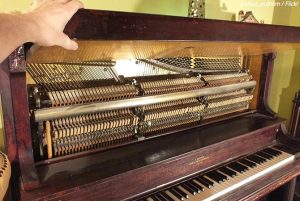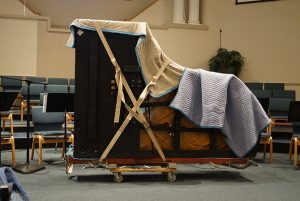


The taller the upright piano, the heavier it is because most of its weight comes from the cast iron harp that holds the strings in place. Cast iron is extremely heavy material so, the taller the piano, the bigger the harp, the more it weighs, and the more it weighs, the more people you need to move it.
If the piano’s height is….
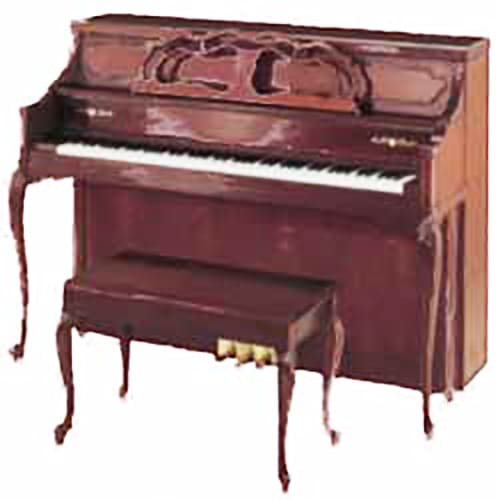
36″ to 38″ = spinet

39″ to 42″ = console
Number of people needed on small upright pianos
Spinets and consoles (36″ – 42″) are considered to be small upright pianos and weigh from 300 to 400 lbs. Small uprights should be moved with at least 3 people, not 2 because then there is no safety or balance person. If more than 4 consecutive steps are to be encountered anywhere in the move path, it is best to have 4 people on it for safety’s sake.
Always plan to have 2 people moving the bottom of the piano (this is called being on heavy in the piano moving industry) if it is being taken up/down stairs, even if there are only 1 or 2 or 3 steps to traverse. This way, if one person trips, stumbles, or slips, then the other person is there to protect them and still keep the piano balanced and stable.
Professional movers who are highly-skilled and experienced can get by with 2 men (one on top, one on the bottom) on a small upright
Sometimes a really tough shot, where the small upright has to be carried 2 or 3 floors or lifted into the air over an obstacle or even flipped upside down to squeeze it in/out/over/around/under an obstacle can require 4 or 5 or 6 men – for these situations we will not give you instructions because in our opinion – injury is 100% certain with inexperienced people. Just use a professional for such a case.
If the piano’s height is….
44″ to 49″ = studio upright
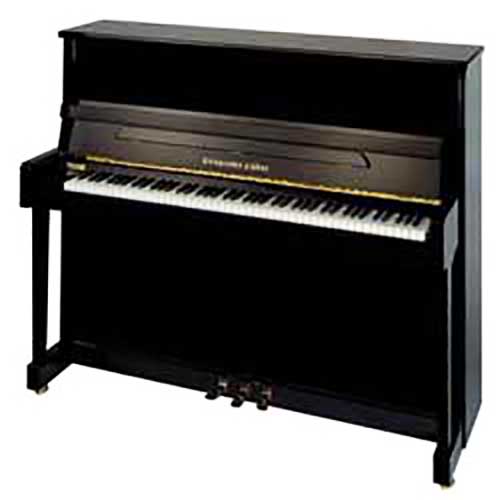
50″ to 60″ = big upright

Number of people needed on big upright pianos
Studio uprights and big uprights weigh from 400 to 900 lbs. When moving these bigger uprights, use at least 4 people, even on an easy shot, and always have 2 or 3 of these people on the bottom (on heavy). Sometimes the heavier weight of these pianos requires at least 4 men just to do a simple dolly-push up a ramp onto a truck.
If a lift-gate truck is used, most lift motors will only handle at most – 1200 lbs. The weight of the piano and a person on each side as it is being lifted can easily hit that poundage so don’t put 3 people on the gate (by the way 2 other men are also needed on the ground to balance/hold the piano as it goes up/down and to work the lift switch).
On big uprights, 5 people are needed. As the piano is moved up/down stairs/landings, people may have to get into corners and have to shift their position around the piano. Otherwise, they’ll get squashed into the turns (in the piano moving industry this is called being burned). As one person is burned out of position, another one has to take over that position.
So, on small uprights – use at least 3 people, but it is preferable to always have 4.
On big uprights – use at least 4 people but preferably 5 or 6.
As we say in the moving industry, make a hard job easy – use enough people.
BASICS OF UPRIGHT PIANO MOVING
There are certain basic steps that must be properly taken (in the following sequence) in order to successfully move an upright piano.
- Determine the number of people needed on the crew for your particular piano.
- All team members must thoroughly study and review the functions of each of the four positions required to move a piano up/down stairs.
- top
- heavy/bottom
- keyboard/bottom
- safety (on small uprights this is desirable but not absolutely necessary)
- Each person is then assigned to one of these four positions.
- The crew mounts the piano up onto the 4 wheel piano dolly.
- They then properly belt the piano tightly to the dolly.
- Next, they thread the humpstrap properly under the dolly. The humpstrap is used by the top man to guide and lift/lower the piano all while it’s belted to the dolly.
- Then they can carefully push the piano to the truck on the dolly keeping it constantly balanced.
- They can dolly it over level ground, over slight inclines and/or cheat it up / down a curb, a stoop or 1 step.
- They can tip it up/down 1 to 4 steps (with the dolly belted tightly under the piano’s side).
- They can dolly it up / down the ramp to get it on/off the truck or up/down the ramp which is removed from the truck and placed over a few stairs.
- They then place it on the truck on its feet and belt it to the truck’s wall.
- Finally, upon arriving at the new residence, they can then dolly it off of the truck and carefully set it in place without damaging or chipping the floors or the piano’s bottom.
All of the forthcoming detailed instruction will thoroughly cover every facet of each of these points so as to make piano moving as easy as possible for you. The goal in all of this instruction is to see you successfully accomplish your piano move without personal injury
Continue to Instruction about Dollying a Piano
In case you are unable to gather up the required helpers to move an upright piano safely, then you must do the right thing and hire professional piano movers. To do this, get free piano moving quotes from the best piano moving companies near you.